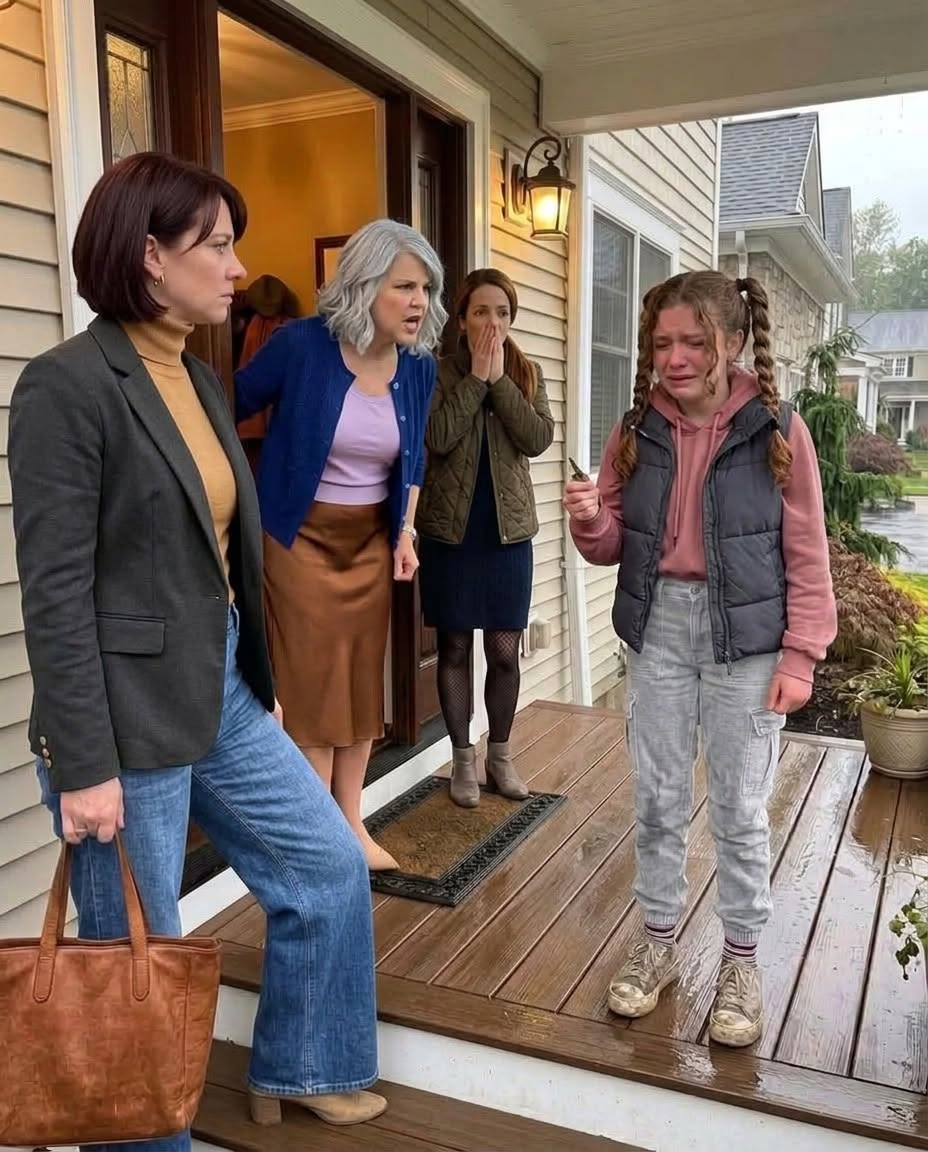
My eleven-year-old daughter returned from school one rainy afternoon and discovered that her house key no longer opened the front door. She waited beneath the covered porch for hours, unable to contact me or anyone inside.
When my mother finally opened the door, she calmly told her,
“We have decided that you will no longer be living here.”
After I learned what they had done, I did not yell.
I did not argue.
I simply said,
“Understood.”
Three days later, my mother received a certified envelope that turned the entire situation against her.
It was 4:12 on a freezing afternoon in Portland, Oregon.
Rain had coated the road in a dull silver shine as Lily stood beneath the porch light, repeatedly turning the brass key I had given her when she began middle school.
It had always worked.
But that afternoon, the key slid into the lock, turned halfway, and stopped.
Lily tried again.
The door remained closed.
Her backpack was already wet when she called me.
Unfortunately, I was inside a basement conference room at the county courthouse, preparing documents for an important custody hearing. Phone reception underground was almost nonexistent.
When I did not answer, Lily called my office.
Then she tried my mother.
After that, she called my younger sister, Natalie.
No one responded.
Thinking the lock might have malfunctioned, Lily sat beneath the porch roof and waited.
The temperature continued to fall.
Eventually, our neighbor, Mrs. Dalton, noticed her and crossed the yard with an umbrella.
“Are you all right, sweetheart?” she asked.
Lily had spent years learning how to avoid upsetting my mother. She understood Evelyn’s cold looks and silent punishments far better than any child should.
So she forced a faint smile.
“I’m okay. I think the lock is broken.”
Mrs. Dalton invited her inside, but Lily hesitated.
She still believed someone in the house would eventually answer the door.
As daylight faded, Mrs. Dalton returned with a warm coat and remained nearby.
Finally, the front door opened.
My mother, Evelyn Mercer, stepped onto the porch wearing a cream-colored cardigan and pearl earrings.
She appeared calm and perfectly prepared.
Behind her stood Natalie and my stepfather, Frank.
None of them looked surprised to see Lily waiting in the rain.
My daughter slowly stood.
“Grandma?”
Evelyn folded her hands in front of her.
“We have all agreed that you will not be staying here anymore.”
Lily stared at her in confusion.
“Where’s Mom?”
“Your mother will understand,” Evelyn answered. “This house is for family members who know how to respect our rules.”
Lily had no idea which rule she had supposedly broken.
She looked at Natalie, then Frank, silently waiting for one of them to explain.
Neither spoke.
Mrs. Dalton stepped forward and wrapped the coat around Lily’s shoulders.
That was when my daughter finally started crying.
I discovered the missed calls at 9:37 that evening.
When I reached Mrs. Dalton’s home, Lily was sitting on the sofa beneath several blankets, holding a warm drink between both hands.
The moment she saw me, she ran into my arms.
“I’m sorry, Mom,” she whispered.
“You did nothing wrong.”
I held her until her breathing became steady.
Then I helped her into my car and crossed the yard toward my mother’s house.
Evelyn opened the door before I had a chance to knock.
She always liked controlling the beginning of every confrontation.
Natalie stood behind her with her arms crossed.
Frank kept his eyes on the floor.
I noticed the newly installed lock.
Then I saw Lily’s soaked backpack lying near the wall.
My mother raised her chin.
“Before you become emotional, Claire, you need to understand that this was necessary.”
I did not raise my voice.
I did not demand to know how she could lock out an eleven-year-old without speaking to me.
I did not argue with Natalie or insist that Frank meet my eyes.
Instead, I looked carefully at each of them and replied with one word.
“Understood.”
Evelyn’s expression changed.
She had prepared herself for anger.
She expected tears.
Most of all, she expected me to beg for permission to remain.
I did none of those things.
I collected Lily’s backpack and walked away.
That night, I took my daughter to a hotel nearby.
We ordered hot soup, changed into dry clothes, and watched an old movie until Lily finally fell asleep beside me.
Only then did I open my laptop.
For years, Evelyn had behaved as if the Portland house belonged solely to her.
She hosted every family celebration there.
She decided who was welcome.
She often reminded us that living under her roof was a privilege.
What she rarely mentioned was how she had received that house.
My late father had purchased the property many years earlier.
Before his death, he placed it into a family trust.
Evelyn had the legal right to live there, but she did not own the property.
The trust identified me as the successor trustee and contained strict conditions governing who could live in the home.
One provision was especially important:
No resident could intentionally remove or exclude a minor beneficiary without the trustee’s permission.
Lily was specifically named as a beneficiary.
And I was the trustee.
My mother had never read the entire trust agreement.
She assumed that occupying the house gave her complete authority over it.
I immediately contacted the attorney who had handled my father’s estate.
I explained everything.
Then I sent him Mrs. Dalton’s written statement, photographs of the replaced lock, records of Lily’s unanswered calls, and a message Evelyn had sent Natalie earlier that afternoon.
It said:
“Once Claire sees that we are serious, she’ll come back ready to obey our rules.”
That message proved the lockout had been planned.
My mother had not acted because of an emergency.
She had deliberately used my daughter to pressure me.
By the following morning, my attorney had prepared the documents.
Three days later, a courier arrived at Evelyn’s front door carrying a thick certified envelope.
My mother opened it in the same living room where she had spent years reminding me that I was only a guest.
The first page informed her that she had violated the family trust.
The second stated that her authority over the property had been suspended.
The third notified every adult living in the house that they would need to arrange new housing unless I personally approved their continued residence.
At the bottom of the final page appeared the name of the property’s legal trustee.
Mine.
My phone began ringing less than ten minutes after the delivery was confirmed.
Evelyn called first.
Then Natalie.
Finally, Frank left a voicemail asking whether we could “discuss everything calmly as a family.”
I glanced across the hotel room at Lily.
She was sitting near the window, working on her homework with her dried backpack beside her.
For the first time since being left outside in the rain, she looked safe.
I turned my phone facedown.
My mother had believed replacing one lock would prove that she controlled our future.
Instead, it revealed that she had never understood who truly possessed the key.